
Every practice has a ceiling that no investment can raise: the doctor's hours. The day does not get longer; the only thing within reach is to stop the hours that exist from leaking away unnoticed.
Most businesses that hit a ceiling add people. A practice cannot. The visit is work only the doctor can do, and that is not a flaw; it is the whole value of the practice. But it means the capacity of the practice is exactly the hours of one person.
This piece is not about working more. A doctor with a full calendar is usually working too much already. The point is a different one: part of the hours already being worked never reaches a patient, and usually nobody sees it. We look at three common leaks from both sides of the desk, and end with a simple way to measure them in a week.
A ceiling that does not move
When capacity is fixed, two options remain. The first is to compress: shorter appointments, more patients per hour. Both sides of the desk pay for that; the patient with a visit that feels rushed, the doctor with the fatigue at the end of the day.
The second is to ask what, out of the current hours, never becomes a visit. This is the gentler option, and it puts pressure on no one, because it adds nothing to the day. It only returns what was already being lost.
We have written about one of these leaks separately: the appointment that stays empty, and its three tools, reminders, deposits and a waiting list. Here we turn to three others that are harder to notice, because they do not empty the calendar. The calendar is full, and something is still lost.
| Leak | From the patient's side | From the doctor's side | A fix that takes nothing from anyone |
|---|---|---|---|
| A full slot for one sheet of paper | Half a day of travel for a two-minute look | A slot that could have gone to another patient | An online visit, taken as seriously and paid for as a visit |
| Minutes lost inside the visit | Repeating the history again; a doctor looking at papers | Hunting for the record, opening several tabs for one question | A record that is ready, with reference and calculation on the same page |
| Attention lost between two patients | A wait with no visible reason | Being called out three times between visits | Every task around the visit has its own place |
One. The full slot spent on a sheet of paper
From the patient's side, the story is familiar. A lab result has come back. To show it, they have to book again, take time off work, sit in traffic and then in the waiting room, for a look that may take two minutes. Some people simply put it off, and a result that should have been seen stays in a bag for weeks.
From the doctor's side, those two minutes took a full slot out of the calendar, one that another patient had been waiting two weeks for. The informal alternative is usually worse: a photo of the result on a personal number at eleven at night, with no record open, nothing documented, and the doctor's work invisible.
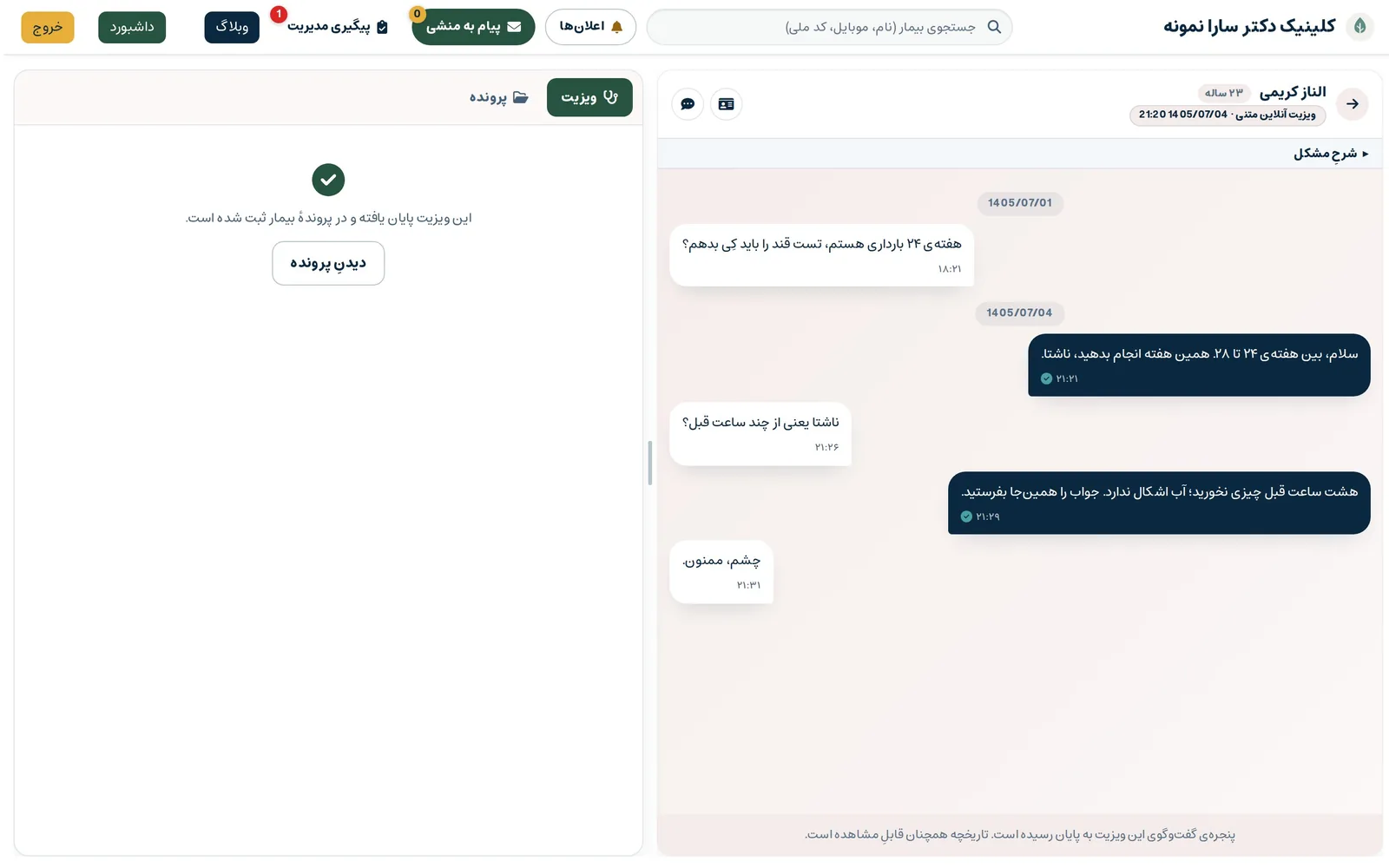
The third way is an online visit, provided it is understood properly. An online visit is the same visit, with the same responsibility and its own fee, for work that does not need an examination. The patient sends the result, the doctor reads it and answers in time set aside for exactly this, and the fee is paid online on the spot. The patient gets half a day back. The doctor gets the visit back.
Three things keep this healthy:
- The call is the doctor's. What can be handled online and what needs an examination is a clinical decision, not a software one. If the doctor reads the result and wants to see the patient, an in-person appointment follows.
- It has its own hours. Online visits without a defined place in the calendar turn into scattered messages all day long, which is a new leak of its own.
- It stays in the record. The conversation and the document that was sent belong next to the rest of the patient's history, not on someone's phone.
Two. The minutes lost inside the visit
The second leak is inside the room, which is why it is rarely counted. The visit has started, but its first few minutes are not a visit.
The record. The patient is seated and the doctor is looking for last time's sheet, or asking the patient which medication was prescribed. From the patient's side, that is their history repeated yet again, to a doctor whose eyes are on paper. A record that is open and ready before the patient walks in, with past visits, current medications, allergies and lab results on one page, gives those minutes back to the patient.
The question that comes up mid-visit. Every doctor sometimes wants to check something: a dose, an interaction, a recent recommendation. That is a sign of care, not of weakness. The leak is not in the checking; it is in the route: closing the record, opening a browser, several tabs, and finding the way back. A search that starts from the working screen and shows trusted sources side by side allows the same care in less time.
The calculation. Gestational age, body mass index, a weight-based dose, a clinical score. Every specialty has a handful of frequent calculations, done either in the head or in a separate app on a phone. When the tools of that specialty sit on the same screen, the calculation is neither forgotten nor an interruption.
None of this replaces the doctor's judgment, and none of it is meant to. It only shortens the way to that judgment.
Three. The attention lost between two patients
The third leak has the smallest minutes and the largest cost. Between two visits, the receptionist knocks: a record is missing, someone is asking about the fee, a caller is holding. Each takes a minute, but the next visit starts with a mind still on the last interruption.
We have opened this up in a separate piece, the work around the visit, with a table of six groups of work that should not reach the doctor and a one-afternoon self-audit. One sentence from it is enough here: every question that has no answer elsewhere eventually reaches the doctor.
One week, one sheet: where the hours go
You do not need software to see these three leaks in your own practice. A sheet of paper at the front desk and one working week are enough.
- Draw three columns: "came only to show a result or ask a short question", "we went looking for something during the visit", "I was called out between two visits".
- The first column is the receptionist's. After each appointment, if the patient came only to show a document or ask one question and no examination took place, one mark. A brief word from the doctor as the patient leaves is enough.
- The second column is the doctor's. One line each time you looked for the record, an earlier result, a dose or a calculation during a visit. Precision is not needed; counting is.
- The third column belongs to both. One mark each time work was broken between two patients.
- At the end of the week, just count. Do not compare the numbers with any other practice; compare them with your own following week.
The result usually takes one of three shapes. A full first column means part of the calendar goes to work that did not need presence. A full second column means the doctor's tools are not where the work is. A full third column means the work around the visit has no owner. Start with the largest column, not with all three.
The sheet shows one more thing that matters as much as the counts: part of the fatigue at the end of the day does not come from the visits themselves.
In the clinic system
In the system we built for practices, each of these three leaks has a defined place:
- Online visits: by text or by phone, in hours the doctor sets and at a fee the doctor sets. The patient books, pays online, and sends the lab result inside the same conversation.
- The conversation: stored encrypted and part of that patient's record, not a message on a personal number.
- The record: past visits, medications, allergies and lab results on one page, before the patient sits down.
- Clinical reference: one search from the doctor's dashboard; result lists from StatPearls and PubMed with their update dates, and direct routes to NICE and WHO. UpToDate opens with the doctor's own subscription. No source text is copied into the system; reading happens on the publisher's own site.
- Calculators: each practice sees the tools of its own specialty, not a list of everything.
- Between visits: a live queue of the patients who are present, and a short message between doctor and front desk inside the same system, instead of a knock on the door.
One thing is better said plainly: the system does not include national-insurance e-prescribing; that part of the work is done, as today, in the insurers' own systems.
Does an online visit mean fewer patients come to the practice?
No. It means every in-person slot goes to work that actually needs presence. Something that would have been settled with one look at a sheet no longer takes the place of a patient who needs an examination, and that same work is no longer unpaid and undocumented.
What should not be done online?
Anything that needs an examination, and anything the doctor has doubts about. The doctor draws the line, and it differs by specialty. The tool only makes carrying out that decision simpler.
Isn't looking something up mid-visit a distraction?
If the route is long, yes. That is the whole difference: one search on the same screen, against closing the record and opening several tabs. Most patients read a doctor checking a source as a sign of care.
Should a practice with few patients think about this?
That practice has a different problem with a different answer. This piece is for the practice whose calendar is full and which still runs short of time.
If you would like to see this for yourself, the live demo walks through three common knots of a practice in three steps each. It is in Persian, with a fictional clinic and synthetic data.
Closing
A doctor's hours cannot be increased. But between the hour written in the calendar and the hour that actually reaches a patient there is a gap, and it can be narrowed: a slot that does not go to a sheet of paper, a visit that does not begin with a search, and attention that stays where it belongs between two patients. All three serve both sides of the desk.
The case study of the practice this system was first built for shows the whole system, from booking to the patient's return. And if you have filled in that one-week sheet and would like to look at it together, the first session is a calm place to start.

Comments (0)
You need to log in to post a comment.
Login / Sign up