
In many practices, the answers to the simplest questions sit with one person: how much came in today, who has paid a deposit, and which patients were supposed to get a call.
That person is usually the receptionist, and usually very good at the job. A good receptionist is a gift. This piece is not about them. It is about the fact that the practice's day is recorded nowhere except in their memory and their notebook, and the doctor, who owns the practice, cannot see it.
What follows is about that dependency: how to spot it, what it costs each side of the desk, and which simple rules reduce it before any tool is involved.
A simple test: if the receptionist is away tomorrow
Suppose the receptionist is away for a week from tomorrow: leave, illness, anything. Who answers these five questions, and from what?
- Who has an appointment tomorrow, and who has asked to move theirs?
- Who has paid a deposit, and for which service?
- How much came in yesterday: how much in cash, by card terminal, by bank transfer?
- Which patients were due a follow-up call, and which of them got one?
- What is waiting for the doctor's decision: which lab result has arrived, which caller had a question?
If the answer to most of these is "we would have to ask them", the practice is tied to one person. That sentence says nothing about the quality of their work. It says something about where the information is kept.
From both sides of the desk
From the doctor's side, the practice has two parts. One happens in the consulting room and is fully visible. The other happens outside it and arrives only as a summary: "today was fine", "a few people didn't show", "I called, no answer". The decisions of the practice, from opening hours to fees and hiring, rest on those summaries.
From the receptionist's side, this is weight, not power. They are the one who has to remember everything, and the one who has to explain whenever a figure does not add up or a call is forgotten. Work they did that was written nowhere is invisible. Taking leave is hard, because they know what will go missing while they are away.
From the patient's side, the dependency shows up as a familiar sentence: "She isn't in today, please call back tomorrow."
All three are living with the same thing: information that should belong to the practice belongs to one person's memory.
How it gets this way
Nobody chooses this. A practice starts with a diary and one careful person, and that works for years. Every day adds something to that person's memory: this patient is always late, that one still owes a balance, that service needs a deposit. None of it is written down, because it never had to be; they just know.
The problem appears on the day that person is not there, or the day the practice has grown past what one memory can hold. Until then, dependency looks like order.
The rule: at that moment, in that place
The fix is not for the receptionist to take more notes or write a report at the end of the week. A report written later from memory is the same memory with a delay. The rule is simpler: every event is recorded at the moment it happens, in a place the doctor can also see.
| Event | What gets recorded on the spot | If it is not |
|---|---|---|
| A patient pays | The amount, the payment method, and which visit or service it is for | The day ends with a figure nobody can trace |
| A patient pays a deposit | The amount and the service it is held for | The deposit blends into income, or is forgotten on the day of the visit |
| A patient asks to move an appointment | The request itself and the reason | The old slot stays empty and the new one has no place |
| A patient is called | The outcome and the patient's own words | The call is made twice, or never |
| A caller leaves a message | Name, number and subject | The call that was going to be returned "later" disappears |
"A place the doctor can also see" can, as a first step, be a shared ledger with fixed columns. The tool is not the point. The point is that recording is part of the work itself, not a separate job done afterwards.
One. Close the cash drawer every day
Money is the most sensitive place where memory does the work. In a practice with several payment methods, "how much did we take today?" has no exact answer at night unless every payment was written against its own visit when it was made.
Closing the day means three short steps every evening:
- Total receipts by method: cash, card terminal, bank transfer, cheque.
- Count the cash in the drawer and compare it with the recorded figure.
- Record any difference, with one line of explanation, that day and not at month end.
After that, the day's figures do not change. The lock protects the receptionist too: a closed day is no longer open to question. A difference seen the same evening is a small mistake whose cause everyone still remembers. A difference seen at month end is distrust whose cause nobody can recall.
Two. Give pending work one list
A large part of a receptionist's memory is a list of unfinished work: who needs a call, which patient left a message, which appointment has to move, what to ask the doctor. While that list lives in someone's head, every new phone call knocks an item off it.
A single list of pending work, with two properties, solves most of this. First, every item shows who it is waiting for: the front desk or the doctor. Second, an item leaves the list only when the work is actually done, not when someone crosses it out.
For the doctor, the list replaces "by the way, I forgot to mention". For the receptionist, it replaces the worry about what might have been forgotten.
Three. Make follow-ups visible, and not to catch anyone out
Follow-up, calling a patient who is due back or who missed an appointment, is the work most likely to go unseen in a practice. A call that was made and not answered leaves no trace unless it is written down.
Recording a follow-up takes three things: how many attempts were made, what the patient said, and how it ended. Those three lines do two jobs:
- For the doctor: they learn why a patient did not come back. "It was too expensive for me" and "your hours don't work for me" are different answers and call for different decisions.
- For the receptionist: their persistence becomes visible. Three unanswered calls to one patient are not three failures; they are one serious follow-up.
If the record turns into a tool for blame, the receptionist will write what looks good instead of what the patient said, and the report becomes worthless. The aim is to see the work, not to find someone at fault.
Does this mean not trusting the receptionist?
No, and it is worth saying so plainly inside the practice. Recording does not replace trust; it replaces memory. A receptionist who does not have to remember everything does the job better, takes leave more easily, and has a record to point to when a figure does not add up.
The best way to begin is to make the receptionist a partner in setting the rules. Nobody knows better what exists only in their own head.
In the clinic system
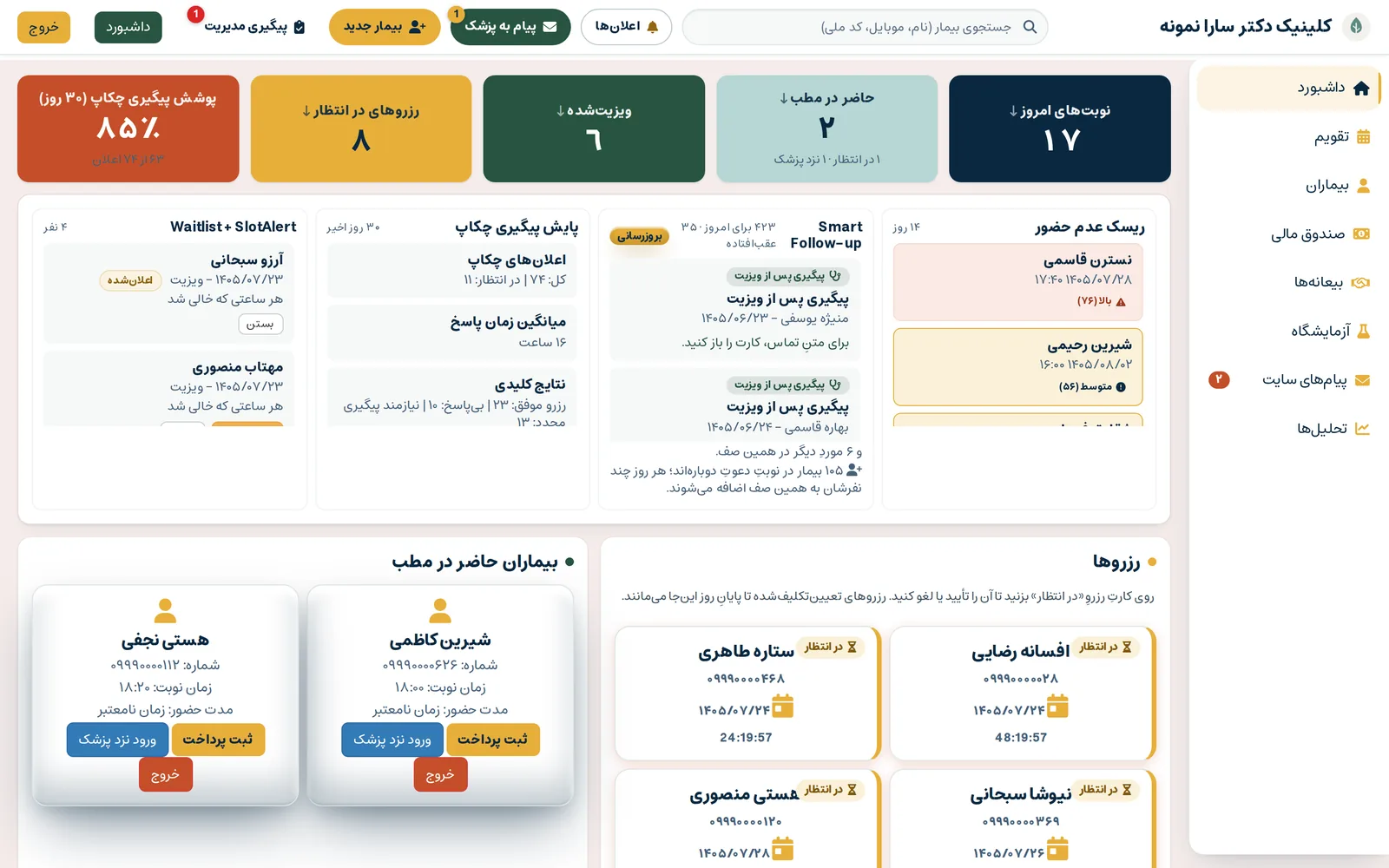
In the system we built for practices, these rules are part of the daily routine:
- Daily statement: every payment is recorded against its own visit, with its method: cash, card terminal, bank transfer or cheque.
- Closing the day: the receptionist counts the cash, reconciles it with the system's figure and closes the drawer. A closed day cannot be reopened, and its summary is sent to the doctor. A day left unclosed is flagged to the front desk.
- Deposits: held apart from income, with the outcome recorded: deducted from the invoice, refunded, or forfeited with a reason.
- Work inbox: one list per role. The front desk sees callbacks, follow-ups and appointments that need moving; the doctor sees appointment-change requests and whatever is waiting for a decision. Each item leaves the list when it is dealt with at its source.
- Follow-up report: one row per patient: how many attempts, what they said, and the outcome.
The case study of the practice this system was first built for shows the whole system, and the work around the visit covers what should not take a doctor's or a patient's time.
Does a small practice with one receptionist need this?
More than a large one. In a large practice, information is necessarily spread across several people. In a small one it all sits with one person, and a day without them is a day without all of it.
Doesn't recording on the spot add to the receptionist's workload?
A little, in the first weeks. After that it reduces it, because the work of rebuilding things from memory goes away: the month-end count, the search for who paid a deposit, the call made twice because nobody remembered how the first one went.
If we take only one step, which one?
Closing the cash drawer at the end of every day. It is short, the result is visible the same evening, and it carries the habit of recording on the spot into the rest of the work.
If you would like to see this for yourself, the live demo walks through three common knots of a practice in three steps each. It is in Persian, with a fictional clinic and synthetic data.
Closing
A practice that lives in one person's head runs well for as long as that person is there. The rule "at that moment, in that place" separates the practice from their memory without taking anything from their value: the receptionist carries less, and the doctor can see their own practice.
If you asked yourself those five questions and would like to look at where each answer lives in your practice, the first session is a calm place to start.

Comments (0)
You need to log in to post a comment.
Login / Sign up