
An appointment a patient misses is an empty hour for the doctor, and for another patient, an appointment they could not get.
Every practice has no-shows. What separates practices is whether an empty slot is lost silently or seen before it empties. This piece puts three simple tools side by side, reminders, deposits and a waiting list, and looks at each from both sides of the desk.
From both sides of the desk
From the doctor's side, an empty slot is not only lost income. It is a calendar that looked full and was not; an hour that can neither be given to another patient nor planned for anything else. When it repeats, the practice drifts towards booking beyond capacity, and the cost falls on the patients who arrived on time.
From the patient's side, it is rarely carelessness. They booked weeks ago and their plans changed. To cancel, they would have to call at a busy hour, and nobody might answer. And on the same day, another patient was told there is nothing free for two weeks.
These two pictures are one problem: between someone who cannot come and someone who wants to, there is no path.
Why appointments stay empty
Booking and reminders are two pieces of the work around the visit: the work that, without a defined place, takes its time from the doctor or the patient. Most no-shows come back to a few recurring causes, and each cause has its own tool:
| Cause | Tool |
|---|---|
| A long gap between booking and the visit | A reminder before the appointment |
| Cancelling is harder than not showing up | A simple way to cancel or reschedule |
| Nothing is at stake | A deposit, under a rule stated in advance |
| A cancelled slot has nowhere to go | A waiting list |
One. Reminders: before the appointment is forgotten
A reminder does two things. First, it reminds the patient of the appointment. Second, and less visibly, it gives them a chance to say early if they cannot come. A cancellation known a day ahead is a slot that can still be filled; a no-show is not.
Two messages are usually enough: a booking message straight away, with the day, date and time; and a reminder on the evening before, when many people look over the next day. The reminder is short and carries no clinical information. "Your appointment is tomorrow at ten" is enough; the name of a condition or a medication has no place in a text message.
Two. Deposits: a small commitment from both sides
A deposit is not a penalty. It is an agreement both sides understand from the start: with it, the patient confirms the appointment, and the practice holds the time for them. So that it does not harm the relationship between patient and doctor, it has three conditions:
- The rule is stated in advance: up to when a cancellation returns the deposit, and what happens after that.
- It is applied the same way to everyone, and every forfeit has a written reason.
- It is deducted from the fee at the visit, so the patient does not see it as extra money.
Not every service needs a deposit. It makes sense where an appointment takes a large share of the calendar or is hard to replace. There is also an accounting point that is often forgotten: until the service is delivered, a deposit is not the practice's income and should be held separately.
Three. The waiting list: a cancelled slot is someone else's appointment
A patient who could not find a suitable time states a preference: which days, what time of day, in person or online. When an appointment is cancelled, the receptionist does not search memory or a diary; they see who this slot suits and let that person know. A booking request that found no suitable time goes onto the same list instead of going unanswered.
From the patient's side, the difference between hearing "we'll let you know" and actually being told is this list. From the doctor's side, an hour that had emptied is filled again.
See the risk before the slot empties
Most practices count no-shows after they happen. It is more useful to see them coming, in two ways:
- Per patient: the patient's own history of missed and cancelled appointments shows which upcoming appointments are riskiest. The receptionist calls those patients first.
- Per time slot: when the no-show rate is calculated for every combination of day and hour, it becomes clear which slots carry the problem. The response differs by slot: a second reminder, an extra booking, or moving that slot.
Does a queue mean popularity?
Some time ago, under one of the Instagram videos in the "Both sides of the desk" series, someone left a comment worth thinking about: practices are sometimes kept crowded on purpose, because patients do not consider a doctor with a quiet waiting room to be skilled.
The comment is not baseless. For many of us, a queue signals a good doctor. But can popularity only be shown in the waiting room? A calendar booked weeks ahead, a waiting list with people on it for cancelled slots, and the satisfaction patients record after each visit are all signs of popularity, without anyone waiting an hour.
A crowded waiting room means the patient's time is paying for the practice's reputation. Demand should show in the calendar, not in the waiting room.
In the clinic system
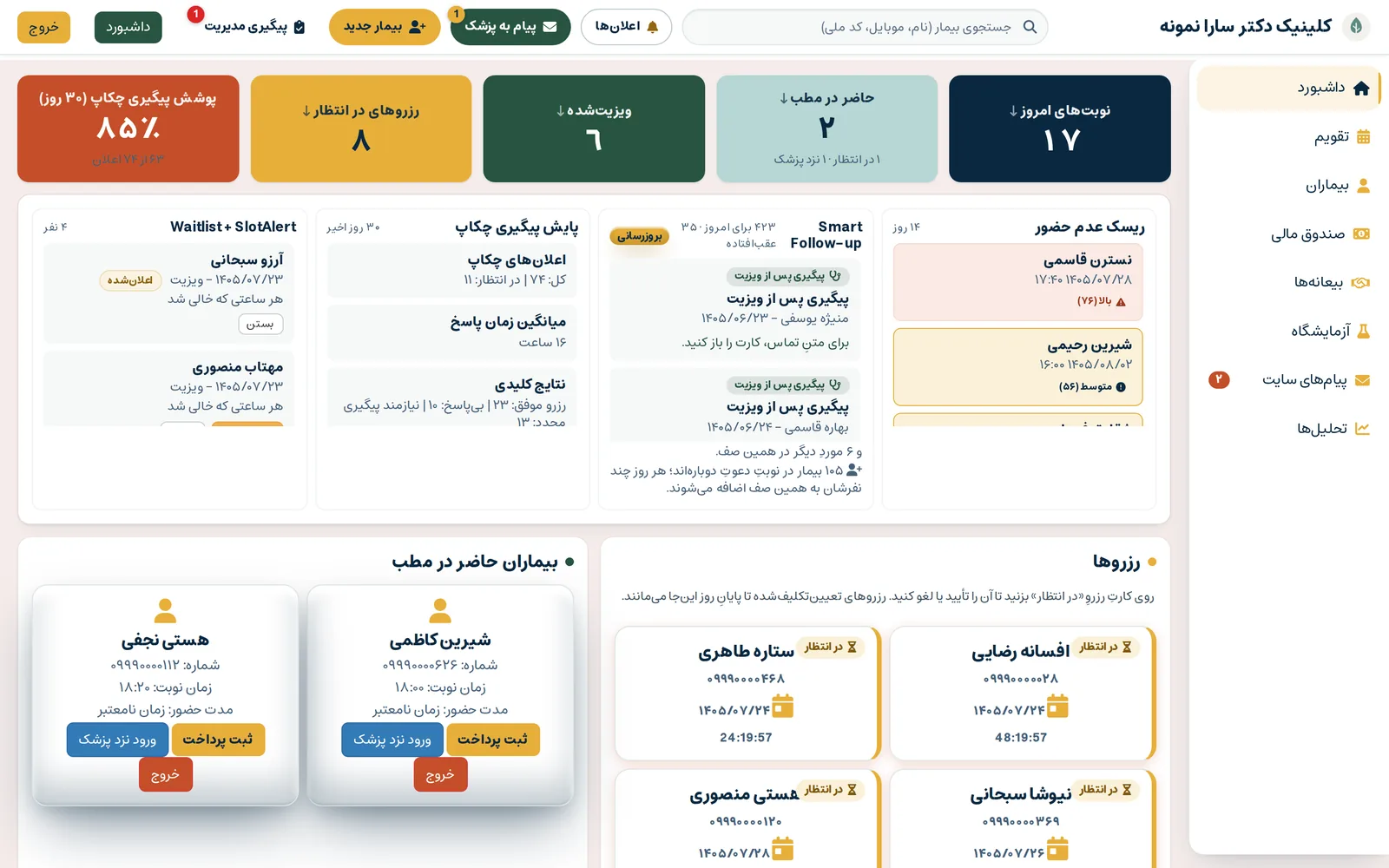
In the clinic system we built, these three tools are connected:
- Text messages: a booking message straight away, and an automatic reminder for tomorrow's appointments in the evening hours.
- Deposits: held apart from income, with the outcome recorded: deducted from the invoice, refunded, or forfeited with a written reason.
- Waiting list: with preferred days, times and visit type; when an appointment is cancelled, the receptionist lets the waiting patient know.
- No-show risk: for upcoming appointments, on the front-desk dashboard.
- No-show analysis: the rate for every combination of day and hour, with a suggested action for that slot.
- Recorded satisfaction: a thank-you message after the visit with a survey link, and every review tied to a specific visit.
Calling patients who missed their appointment can also be handed to an AI agent. The criterion is objective, and the patient booked the appointment themselves, so the call is not unexpected.
Doesn't a deposit drive patients away?
It depends on how it is presented. A rule announced in advance and applied equally reads more as order than as distrust. A practice can start with the services where an empty slot costs the most.
When should the reminder go out?
Early enough that, if the patient cannot come, the slot can still go to someone else, and close enough that it is not forgotten. The evening before is a good starting point for most practices; the practice's own data shows the best time.
Is a waiting list worth it with only a few names?
Yes. The goal is not a long list; it is that a cancelled appointment has somewhere to go.
If you would like to see this for yourself, the live demo walks through three common knots of a practice in three steps each. It is in Persian, with a fictional clinic and synthetic data.
Closing
An empty appointment is usually nobody's fault; it is a sign that there is no path between the patient who is not coming and the patient who is waiting. A reminder opens that path, a deposit makes it serious, and a waiting list gives it a destination.
The case study of the practice this system was first built for shows the whole system, from booking to the patient's return. And if you would like to see in which slots, and for what reasons, appointments stay empty in your practice, the first session is a calm place to start.

Comments (0)
You need to log in to post a comment.
Login / Sign up