
There is one piece of work in a medical practice that cannot be handed to anyone: the visit itself. Nearly everything else can, and whatever is not handed off takes its time from the doctor or from the patient.
Look at an ordinary afternoon in a practice from both sides of the desk. On one side, a patient who arrived on time and is still waiting. On the other, a doctor who has been called out three times between two visits: a record cannot be found, someone is asking about the fee, a caller is holding on the line.
The two experiences are connected. Every interruption that delays a visit adds minutes to the next patient's wait. This piece is about that work around the visit: what it consists of, why it ends up with the doctor, and how to measure it in a single afternoon.
This side of the desk: the patient who had an appointment
Patients rarely see what happens behind the front desk. They see only the result:
- They had an appointment and still waited, without knowing for how long.
- They called several times about a lab result and heard "later" each time.
- They explained their medication history for the second or third time.
- They asked about the fee at the desk and got no clear answer.
- They left without knowing when to come back.
None of this has anything to do with the doctor's knowledge. It is all work that happens around the visit, and when it has no defined place, its weight lands on the patient.
The other side: the doctor called out between visits
From the doctor's chair, the same afternoon looks different. A visit ends, and before the next patient the receptionist knocks: a record is missing, a patient on the phone wants to ask "just one question", a lab result has arrived and nobody knows who should be told, the previous visit's bill is still open.
Each interruption takes only a few minutes. Their real cost is not in the minutes but in the attention they take with them. The next visit starts later, with part of the doctor's mind still on the last interruption. By the end of the day, the fatigue comes from a place no report shows.
Most of these interruptions are nobody's negligence. When information lives in one person's head, or is scattered across a paper diary and several separate apps, every question that has no answer elsewhere eventually reaches the doctor. Without anyone intending it, the doctor has become the practice's backup memory.
One rule: the visit cannot be delegated; everything around it can
Work around the visit means anything that happens before, after or alongside the visit and does not require the doctor's clinical judgment. The table shows six common groups from both sides of the desk:
| Work around the visit | From the patient's side | From the doctor's side | Where it belongs |
|---|---|---|---|
| Booking and rescheduling | Calling at busy hours, holding on the line | A calendar only the receptionist knows | Online booking confirmed by the front desk, on a calendar everyone can see |
| Reminders | Forgetting an appointment booked weeks ago | A slot that empties without warning | An automatic message before the appointment |
| Records and history | Repeating history and medications again | Searching for a sheet or a note | A record that is ready before the patient walks in |
| Lab results | Repeated calls for a single result | Not knowing whether a result has arrived | The result filed in the record and the patient's portal |
| Billing and payment | Uncertainty about fees and balances | Accounts that do not reconcile at month end | Settled on the spot, with a clear history |
| Follow-up after the visit | A question that comes up at home | Messages on a personal phone | A conversation open for a few days that is part of the record |
The last column does not name a tool; it names a place and an owner. Until each of these has a defined place, its question goes looking for the person who knows the answer, and that person is usually the doctor.
The first two rows of this table, booking and reminders, lead to a separate problem that deserves a piece of its own: the appointment that stays empty.
A one-afternoon self-audit: one mark per interruption
You do not need software to see this work in your own practice. A sheet of paper and one working afternoon are enough.
- Draw a simple table with four columns: time, who interrupted, why, and whether the doctor was actually needed.
- Mark a full afternoon. One line every time a visit, or the gap between two visits, is broken by a question. If the doctor has no time to write, the receptionist writes it down.
- Count the patient's side too. The receptionist adds a separate mark each time a patient asks "how much longer?" or calls about a result, a fee or an appointment.
- At the end of the day, group the marks: booking, records, labs, money, phone, questions after the visit.
- For each group, ask: if the right information had been in the right place, would this question have been answered without the doctor?
Most marks usually come back to a handful of causes. Start with the largest group, not with all of them at once. One change that removes an entire group of questions does more than ten small ones.
Record every event once
The principle that takes this work off the doctor is simple: every event is recorded once and reaches the next person on its own. A confirmed appointment is on everyone's calendar. A patient who checks in appears in the doctor's queue. A result from the lab lands in the record and is available to the patient. A bill settled at the desk is in that day's financial report.
When recording happens once, the doctor does not need to ask and the patient does not need to repeat. The receptionist stops being the practice's memory and becomes the person who sees things through.
In dentistry the arithmetic gets sharper, because every tooth carries its own history and most treatments run across several appointments.
Where this work sits in the clinic system
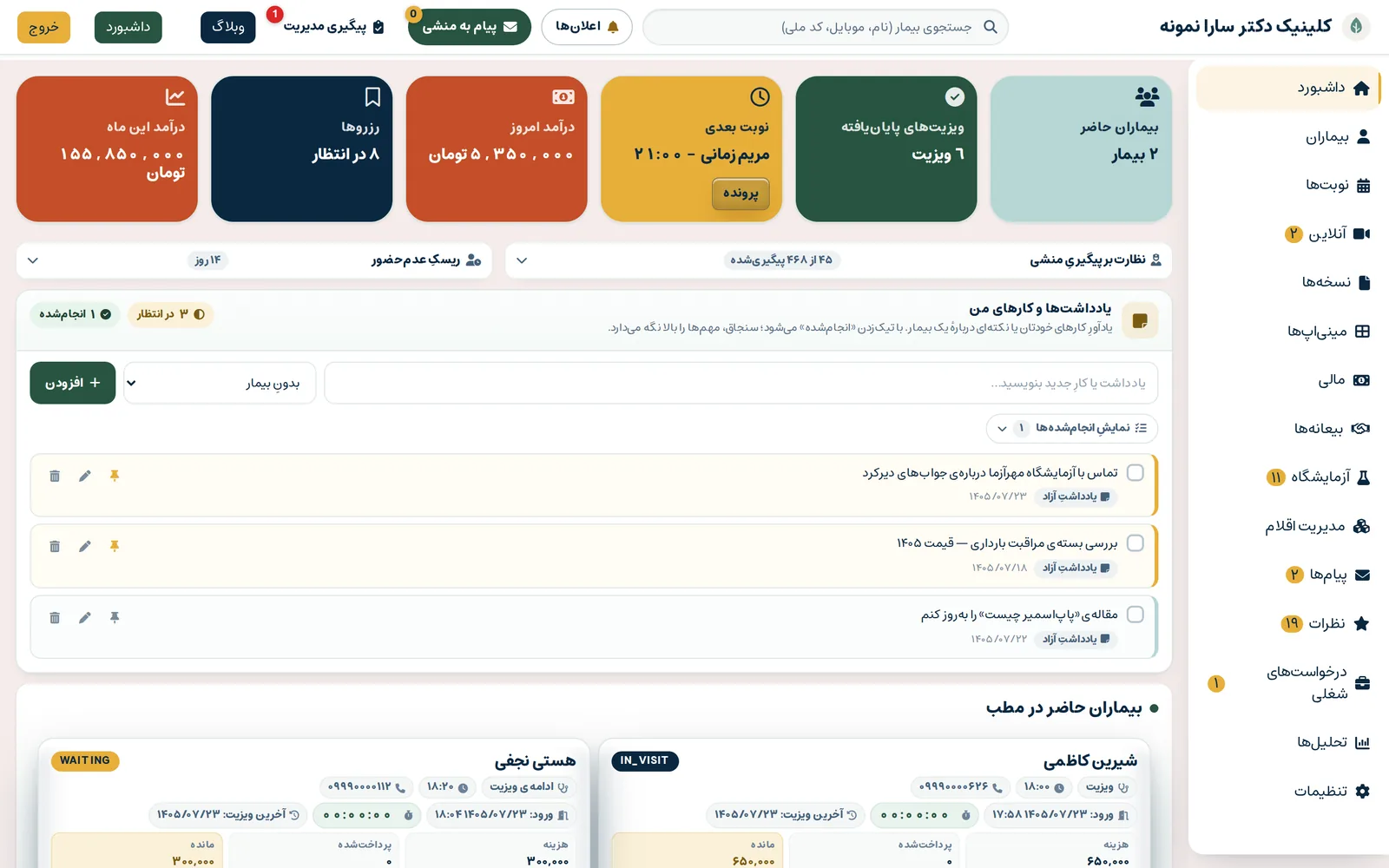
The clinic system we built rests on the same principle. A few examples of where each piece of work around the visit sits:
- Booking: patients book with their mobile number and a one-time SMS code, and the front desk confirms. No request goes unanswered, because the time it arrived is visible.
- Queue: on check-in, the patient joins a live queue that the doctor can also see, and the waiting time is measured.
- Record: visit history, allergies, current medications and lab results with trend charts, on one page.
- Labs: the front desk logs each sample and follows up results that are late; the result reaches both the record and the patient's portal.
- Payment: settlement is recorded at the desk, and a deposit is held separately until the service is delivered.
- After the visit: the next visit date appears on the record and in the patient's portal, and a two-way conversation stays open for a few days for follow-up questions.
- Between doctor and front desk: a short message inside the same system, instead of a knock on the door.
Part of the repetitive follow-up can also be handed to an AI agent: reminders, calls to rebook a missed appointment, a check-in a few days after the visit. The boundary is the one this whole piece draws: repetitive work around the visit, never clinical judgment.
Does this mean a practice needs less front-desk staff?
Not necessarily. The receptionist's work changes: instead of remembering, they see things through. What comes off their shoulders is memory, not the role.
Does a small practice with one receptionist need this?
Perhaps more than most. When all operational knowledge lives in one person's head, a single day off or a change of staff means part of the work goes missing.
If we take only one step, which one?
The one-afternoon self-audit. Before any tool, it shows exactly where the doctor's and the patient's time goes in your practice.
If you would like to see this for yourself, the live demo walks through three common knots of a practice in three steps each. It is in Persian, with a fictional clinic and synthetic data.
Closing
The visit belongs to the doctor. The time around it belongs to both sides of the desk. Every task that moves forward without the doctor gives a few minutes back to the visit and takes a few minutes off the patient's wait.
The case study of the practice this system was first built for shows how it runs day to day. And if you have counted the marks from that afternoon and would like to look at them together, the first session exists for exactly that: seeing how your practice actually runs, before any tool.

Comments (0)
You need to log in to post a comment.
Login / Sign up